
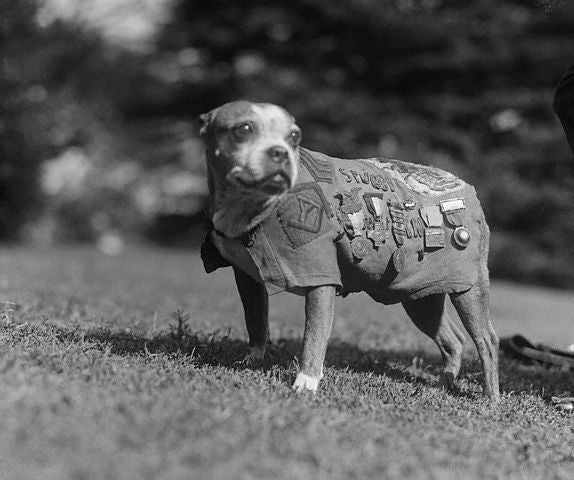
In honor of K-9 Veteran’s Day on March 13th, Allivet wanted to share the story of Sgt. Stubby, a dog who went from homeless to hero.
By all accounts, Sgt. Stubby lived an impressive life. He went to Yale, joined the Army, and fought in World War I. He saved the lives of many of his comrades, was wounded in Battle, and single-handedly captured and detained a German spy lurking in Allied trenches – an act for which he was advanced to the rank of Sergeant, thus outranking his best friend, a human.
He was celebrated by the French and English, whom he helped liberate, met three U.S. Presidents, led post-war parades all over the country, and was asked to sit for a portrait painted by a famous American artist. He went to Georgetown Law and earned himself a place of honor at the Smithsonian Institution. Not bad for a dog.
The Early Years and Joining the Ranks
Stubby’s odyssey began in 1917 in New Haven, Connecticut, somewhere on the periphery of Yale University. Likely born in 1916, his pedigree was as fortuneless as the doughboys he would serve with in the trenches on the Western Front. He was homeless, probably looking for something to eat, or to better himself through education, when he wandered onto Yale Field and happened upon the U.S. Army’s 102nd, Infantry, 26th Yankee Division. The division was training for their looming deployment to the European theater. Private J. Robert Conroy and Stubby met on the field and became fast friends. Initially, through his association with Conroy, Stubby became the mascot for the division, but it was clear to all that due to his intelligence he would soon be regarded as more than just a furry figurehead.
Stubby didn’t just learn to sit, stay and fetch. With training from Conroy and the 26th, he soon understood bugle calls, flawlessly took part in complex marching drills, and even learned to salute officers along with the rest of his division. Stubby led marching drills in parades and knew to face right during pass in review.
When it came time for the 102nd to go, Private Conroy smuggled Stubby onto a southbound train in his trench coat. When they arrived in Newport News, they were to board the U.S.S. Minnesota bound for the battlefields of Europe. Since the ship wasn’t to get underway for a few days, Conroy had time to make the right connections with the crew to get Stubby on board and stow him away in a coal bin until they were underway.
After the U.S. coastline disappeared off the stern, Stubby was out in the open and quickly won over the crew. When the CO eventually came across Stubby, the dog sat on his hind haunches and gave the Skipper a proper salute. After that, no one questioned Stubby’s presence on board a Navy ship.
Becoming a Hero
Stubby saw action in 17 battles on France’s Western Front. He was wounded by exposure in a mustard gas attack, after which he developed the ability to detect incoming gas and was able to alert his comrades in time to don their gas masks and help Stubby don his own. He would stand watch with his mates, and those who have stood a post know having a companion is much easier than doing it alone. Stubby also learned to alert the division of incoming artillery since he could hear the “whine” of approaching shells long before his human counterparts. He would venture into no man’s land to lead wounded soldiers back to the trenches, and he stayed by dying friends until they passed.
One day Stubby came upon a German soldier in Allied trenches. The soldier was a spy marking the location of Allied troops for future attacks. Stubby, recognizing the soldier was speaking German and not English, started barking to alert his fellow soldiers of the intruder’s presence. When the soldier tried to get away, he lunged at him and grabbed him by the leg. During the struggle, Stubby got a better grip on the spy by biting down firmly on his caboose as securely as the coupling between two train cars, and he detained the enemy until backup arrived. For this action, the commander of the 102nd recommended Stubby for promotion to Sergeant. The promotion was approved, and he now outranked his friend Cpl. Conroy.
Not long after, while on duty outside the trenches, Stubby was wounded a second time during an artillery strike, taking shrapnel in the chest and front legs. Cpl. Conroy, risking his own life, crawled into no man’s land to save his friend. After getting him to safety, Stubby was transferred to a field hospital and then a Red Cross Recovery Hospital.
Stubby arrived at the front lines with the sole duty of keeping up morale, but during his 18 months in the trenches, he continued to learn new skills, and he became an integral part of the 26th Yankee Division.
A Hero’s Welcome and the Post-War Years
Sgt. Stubby’s first stop on the way home was Paris, where he received a hero’s welcome from the people of France. On Christmas Day in 1918, he met President Woodrow Wilson, who had signed the armistice in November. Stubby would not have to stow away on the transport back Stateside. Instead, he marched proudly up the gangway of the U.S.S. Agamemnon, his jacket decorated with the rank and awards of a soldier. One of the medals he wore was a German Iron Cross taken from the spy Stubby captured, and it was pinned on his jacket, so it hung directly over his buttocks.
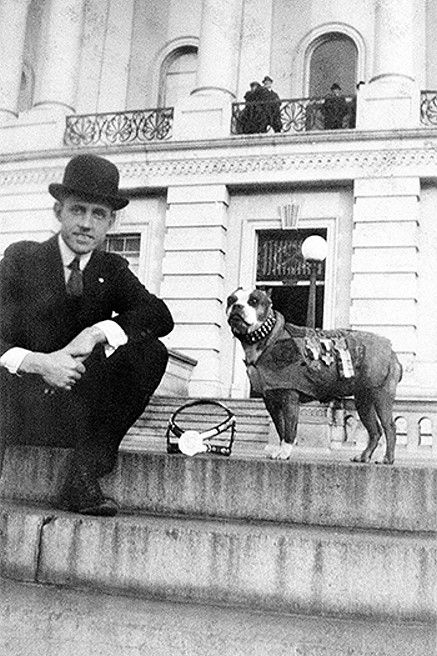
The 102nd Infantry 26th Yankee Division made port in Boston and was demobilized on April 29, 1919, at Camp Devens, Massachusetts. It was then Stubby began his next assignment: being loved by the entire country. City by city, one post-war parade at a time, he led his division in the marching drills he learned long ago on Yale Field. Stubby appeared in Vaudeville shows, attended the 1920 Republican Convention, and was invited to the White House twice by two different Presidents. His first White House visit was in 1921 with President Harding, and his second was for dinner with President Coolidge. That made three times that Stubby held audience with U.S. Presidents.
Conroy and Stubby ended up at Georgetown University in Washington D.C., where Conroy studied law, and Stubby pursued a passion for athletics as the mascot for the Hoyas, where it is purported that he invented the halftime show. During halftime, Stubby would entertain the crowd by pushing a football around the field with his nose. If all that wasn’t enough, Stubby and Conroy had the honor of being photographed with General Pershing, Commander of U.S. forces in Europe. Pershing pinned a one-of-a-kind award on Stubby that was created specifically for him: the Humane Society Gold Medal. He also sat for a portrait painted by noted American and U.S. Capitol artist Charles Ayer Whipple.
Farewell to a Hero
Stubby died in Conroy’s arms, passing away peacefully in his sleep on April 3, 1926. The day after, he was honored with an obituary that took up an entire half-page in the New York Times. The whole country mourned the loss of a genuine American hero, icon, and good boy. His lifelong friend Cpl. J. Robert Conroy had Stubby preserved and kept him at home. In 1956 Conroy transferred Stubby to his final duty station, Smithsonian’s National Museum of American History, to take a place of distinction in the Price of Freedom hall, where he stands eternal watch.
 0
0
 0
0